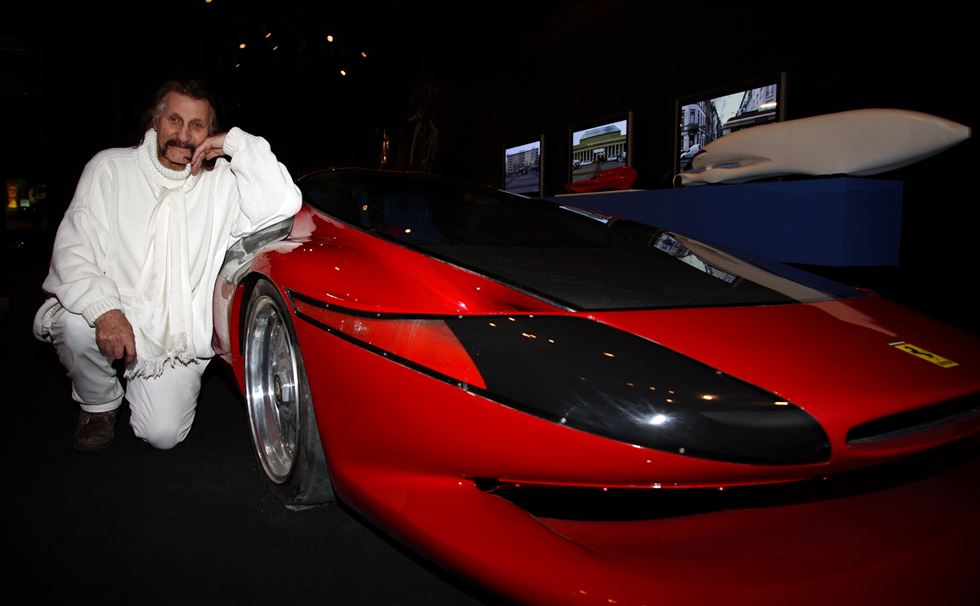
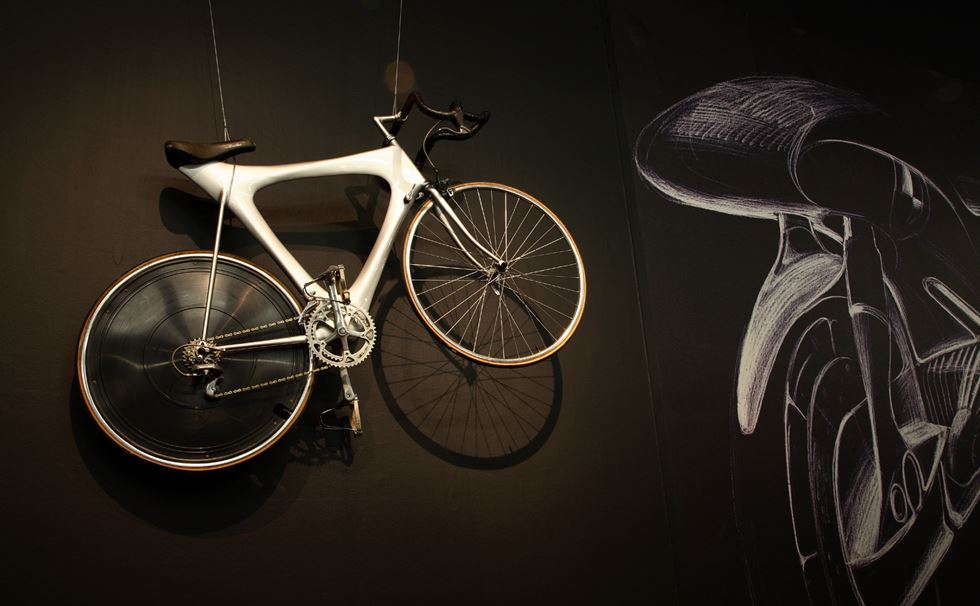
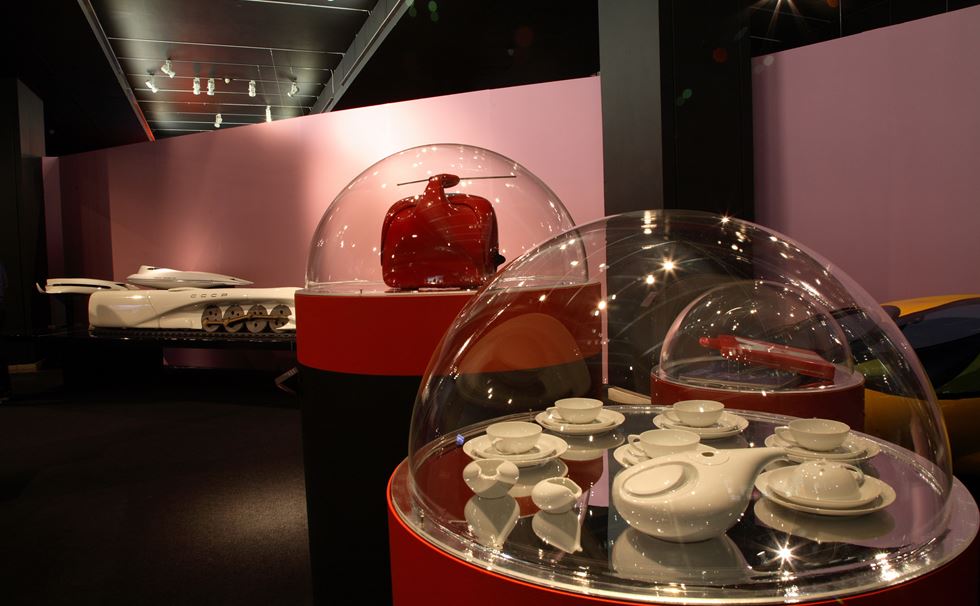
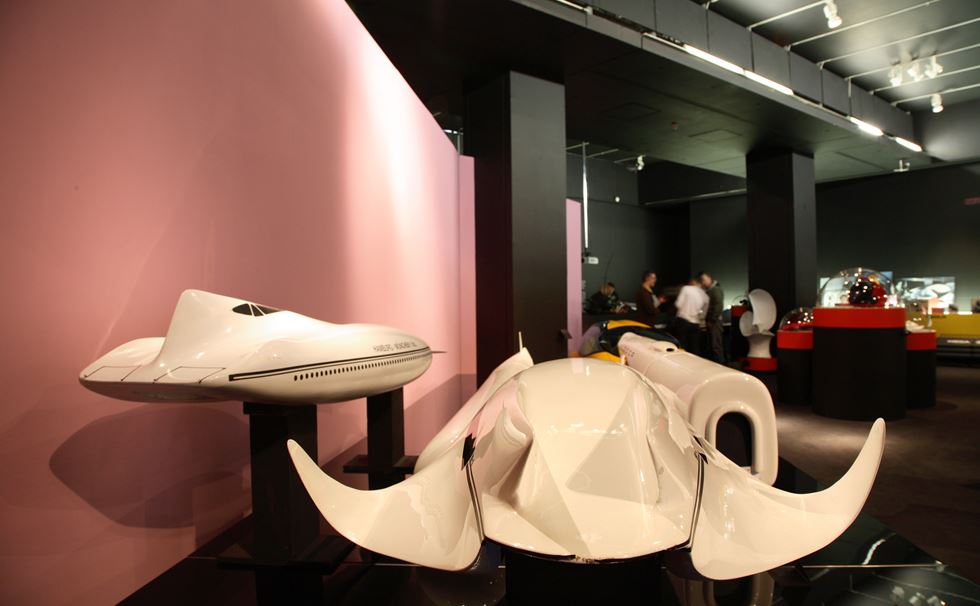
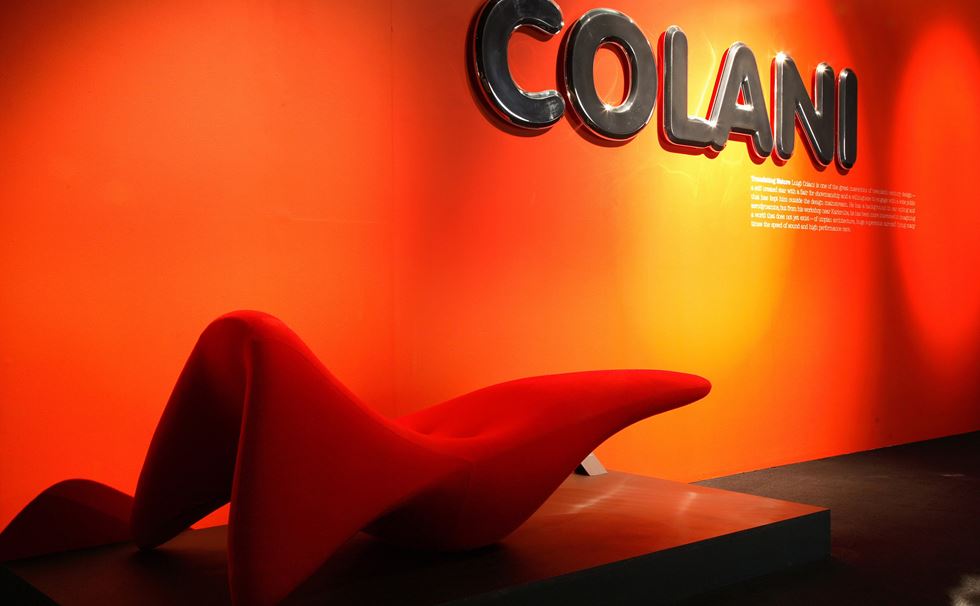
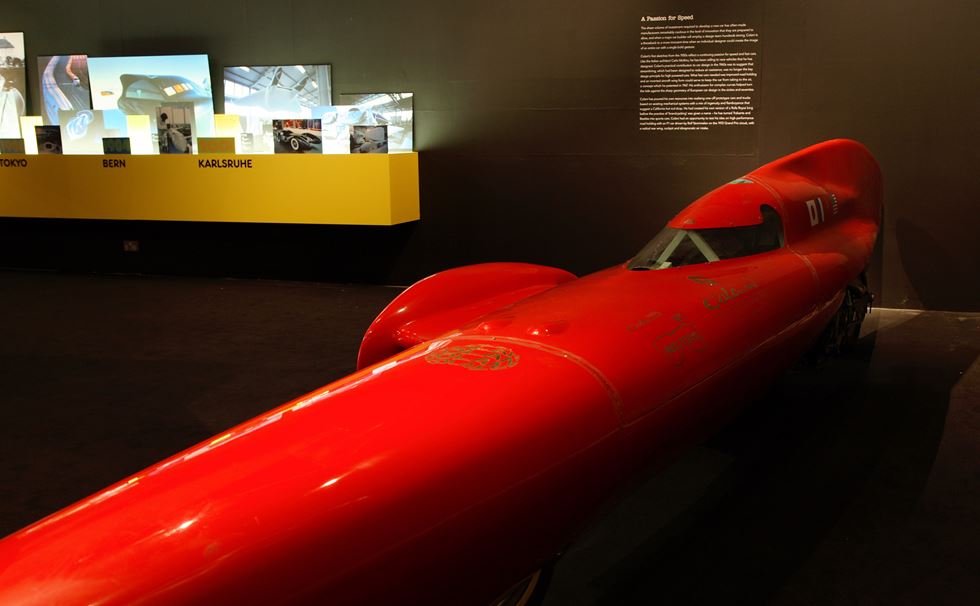
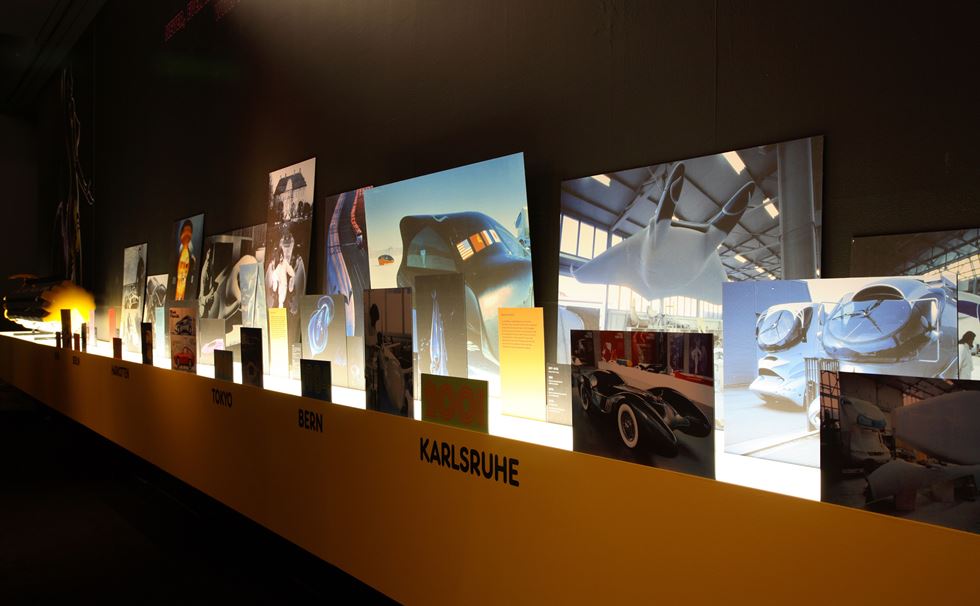
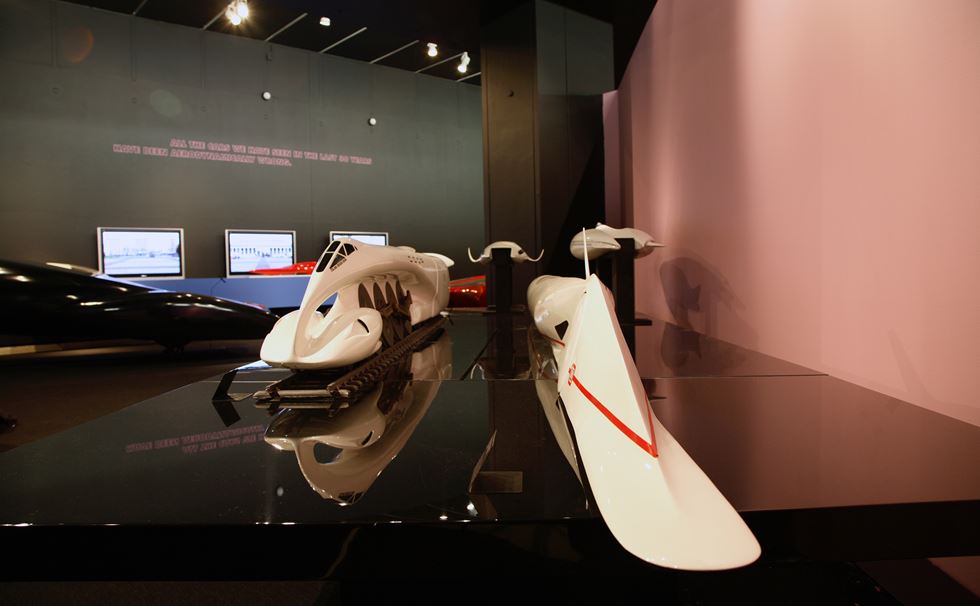
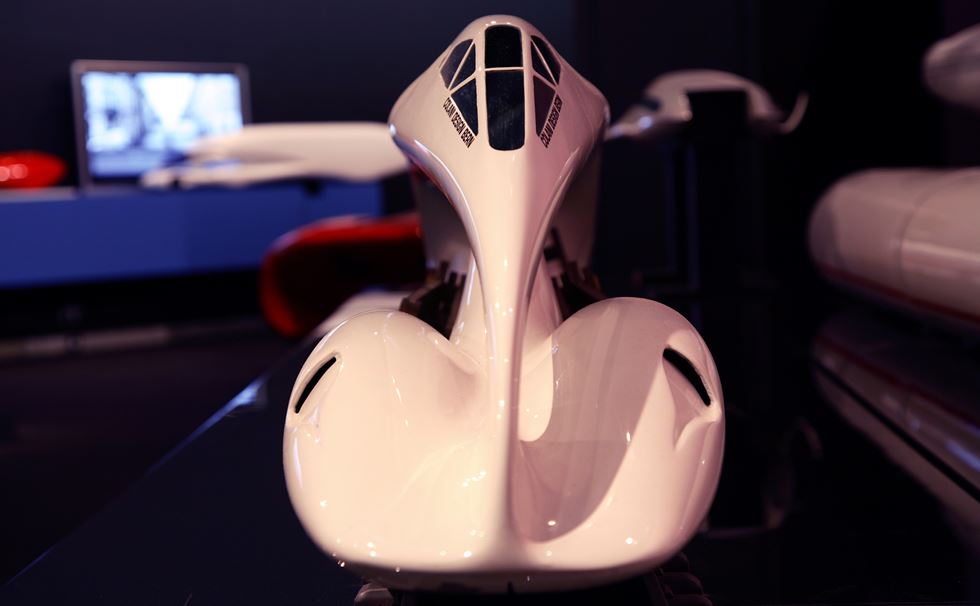
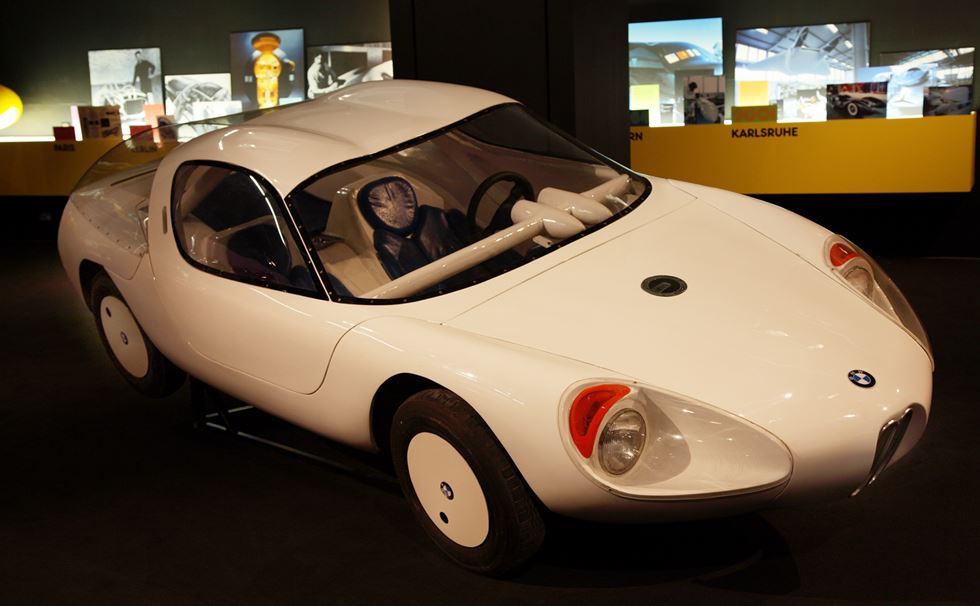
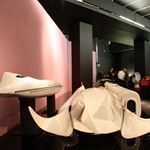
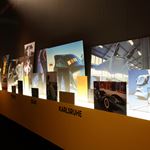
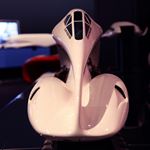
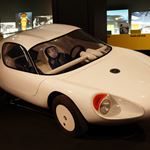
Luigi ColaniTranslating NatureAircraft and product designer (1928- ) 03 March - 17 June 2007 "Whenever we talk about ‘biodesign’ we should simply bear in mind just how amazingly superior a spider’s web is to any load-bearing structure man has made. From this insight, we should look to the superiority of nature for the solutions. If we want to tackle a new task in the studio, then it’s best to go outside first and look at what millenia-old answers there may already be to the problem." Luigi Colani, 2007. LUIGI COLANI is one the great mavericks of 20th century design with an independent spirit, a flair for showmanship and a willingness to engage the wider public that has kept him outside the design mainstream. With a background in car styling and aerodynamics, Colani has pursued an interest in imagining a world that does not yet exist – one of utopian architecture, high performance cars and huge supersonic aircraft flying many times the speed of sound and. Born in Berlin in 1928, Colani dropped out of art school and moved to Paris as a 19 year old. He worked as an illustrator in the advertising industry where he produced a series of speculative ideas for cars, motorcycles and aircraft that combined new technology with new materials and which were styled to look ‘modern’ in the bleak context of post-war reconstruction. Colani worked for a number of car makers and coachwork builders before setting up his own studio in Germany. From his workshop, located in a converted castle near Karlsruhe, his team continue to work in fibre glass to create the shapes and machines that inspire and interest him. Colani and his team often work on several projects at the same time; an unusual characteristic for a studio within the context of an increasingly commercial design world. Driven by curiosity and experimentation beyond the need to simply satisfy a client, the studio might develop and then abandon a concept for years yet later return to similar themes. Inspired by natural, organic forms, especially sea creatures, but also by explicit sexual imagery, Colani was an isolated voice during his early career in the 1950s and 1960s in his obsessive search for a design language that goes beyond the mundane functional world. Today the energy and exuberance of his shape making look much more at home in the context of ‘blob’ architecture and the complex curves made possible by digital technologies. From his earliest projects, ranging from model making for racing teams in Paris and producing DIY kits to customise VW chassis, or more recently building his own trucks in fantastically organic forms, Colani has always looked to subvert mass production. Some creations have made the translation from concept to commercial products such as his SLR T90 camera for Canon and Cobra headphones for Canon. There are also Colani-designed tea pots, mineral water bottles and sun glasses in production, but the majority of his inspired work remains in the form of dreamlike, organic models or photographic montages. © Design Museum Q. How did your career as a designer begin? A. I’m an aircraft designer originally. I’ve never thought of myself as a product designer. I started working with sculpture and then cars. However, I soon realised that trying to be an artist who designed cars was impossible within such a commercial industry. So I went to the L’Ecole Polytechnic and the Sorbonne in Paris to study and I became a rather well-known aerodynamicist. Q. Your early work seems prophetic of the digital age. When you look at the work produced on computers today, do you think that the technology has given the designers more freedom or do you feel they rely too much on technology? A. When I’m drawing, I’m building up from one to three-dimensions and then the power of my ideas, borne within the process of working through the three-dimensions, can be released. I feel that young designers who rely only on the computer and its possibilities are not able to go all the way; they are limited. When the computer can completely and naturally ‘think’ in three-dimensions then it will be more powerful. Q. You’re a professor at three separate institutions in China. Is this a problem that you experience with your students – do they rely too much on the computer? A. China is still a very young culture when it comes to design. Although they are very familiar with computer technologies, they are very new to conceptual training. As a professor, I try hard to encourage them to draw, the old art of drawing and sculpting in three-dimensions. When a student designs something like a handle on their computer screen and when you touch it later, it often feels wrong. But when you start with a piece of clay, sculpt the handle and then you put your hand around it, it’s absolutely perfect. It’s only then that I tell my students they should start to put the design into the computer for digitising. That’s the right way. Q. Your collective body of work seems to have remained remarkably free of commercial constraints. Do you think designers are put under too much pressure to produce work that is too focused on commercial success? A. Well, I think they have to earn their ‘soup’ to survive – this is the part-prostitution that exists in every designer’s life. You have to say ‘yes’ to everything at first to earn money. But the real difficulty comes when you start to become successful; then you must start to say ‘no’. That’s what I did and I’ve stayed glued to my convictions. Q. Do you think that the general consumer– although they are exposed to design regularly through the media – is less confident and connected with determining good from bad design than ever before? A. We are all victims, even critical eyes like mine, because we are surrounded by commercials and so we buy any old rubbish that’s around. We have to regain our ability to be [discerning] and this can only be done if we get nearer to nature. If you look closely, nature immediately starts to correct its own design flaws and so the things that survive are nearly perfect – look at fish, specifically sharks and mantas. We are too far away from nature and so we can’t critically differentiate between good and bad design. People are buying stupid stuff because they don’t know any better. Q. The conceptual and aesthetic influence of the Bauhaus and Modernist figures such as Le Corbusier and Mies van der Rohe continue to be of great influence on many emerging architects and designers today. Do you think Modernism continues to exert too much influence on contemporary design? A. What is ‘Modernism’ exactly? It’s been so confused over the years that it’s lost any real meaning. There are very few ideas from the Bauhaus that survived in their original form. Gropius’ heritage and vision for the Bauhaus included vivid colours in his manifesto – red, blue, yellow. [Colani draws a picture of a circle, pyramid and square stacked vertically – the symbolic logo of the Bauhaus]. But what happened through the ages? There was suddenly no work using the form of the circle or pyramid. Just the square, steel and glass and no colour! This is only 33% Bauhaus. Q. Do you get inspiration from materials – new materials in particular? A. In the past, using fibreglass has given my work 100% freedom. You take Styrofoam blocks, cut the shape with hot wire, sculpt roughly, then mould with a wire brush and sandpaper, pour fibreglass into the mould then clean and paint. It’s absolutely free but we’ve realised that it is not an environmentally sustainable material so we have started to work with wood and bamboo. Bamboo does not give you the same freedom but it grows at an incredible rate and so it makes an extremely sustainable building material. We are also ‘farming’ bamboo that is very strong, extremely light and, of course, utilising only air and water to grow – it is the building material of the future! Q. Environmentally sensitive design must feel as though it’s always been a part of your work with your commitment to using forms sourced from the natural environment? A. I built the first streamline truck in 1971, as a direct response to the world oil crisis yet nobody noticed my design. They didn’t get the message. Earth is going into crisis because we are not reacting the way we should. Look at the automobile industry! I am the world record holder with a four-seater car that used 1.7 litres of fuel over a 100km distance and that was fifteen years ago but nobody took notice. Today the industry continues to market enormous cars that use more and more fuel – It’s crazy, they just don’t get the message that we have to react immediately! Q. Do you see a future for design or do you think that, as a collective society, we should design and consume less? A. In its current form, I don’t believe there is a future for design. Designers tomorrow must be three-dimensional philosophers. They must ask themselves questions. Are we doing the right thing? Are we employing the materials as intelligently as we should? When history revisits this century, it will be called the ‘criminal century’ and our legacy will be excessive consumption and environmental disaster – it’s terrible! To remain optimistic, the only choice for designers is to go back to nature– we must build with natural materials. Q. Beyond organic forms, your work also draws on human sexuality and erotica – can you describe the significance of this to your process? A. I believe that all good design is naturally erotic. However, the western world and America particularly, talk about sex constantly and yet are completely removed from its natural significance to our humanity. In contrast, in Asian society it’s very unusual to discuss sex publicly and yet their culture is full of soft, erotic shapes, sounds, smells and music. The result is that their culture seems one that is floating in harmony and I think we can learn from this. Q. The British designer, Ross Lovegrove, is a great fan and has said that he was enormously influenced by your work as a young boy. Conversely, what is it about Lovegrove’s work that you particularly engage with? A. Ross is an enormous human being and I love his work – sometimes he gets too far away from nature, in my opinion, but that is very rare. We collaborate occasionally on projects. Recently I made a large sculpture at my workshop for his exhibition in Tokyo because his studio couldn’t accommodate the huge scale required. We respect each other as designers and I think Ross is a future giant of the industry. Q. Do you think your studio’s way of working lies more in a ‘fine arts’ tradition than someone like Lovegrove, who works with both hand and digital processes? A. Well, we don’t have any tradition at all. I believe that people who have traditions are narrow-minded. My day is very simple and starts like this: I get up early seven days a week, I go to the baker and put on the coffee, then I go to the studio and see what the team has done the day before – I’m the ‘Hausmeister’, if you like. Then when the team arrives at 8am, we sit and discuss for an hour or two, eating and drinking and having a conversation about everything – politics, philosophy and the products they are working on. We are a team that looks into the future and sometimes we work on projects that might take twenty years or more to be realised. So it is a very slow process and it’s important that we enjoy being together. At 10am I go to my own studio and work until late at night. I need to work alone; sculpting and drawing. In that respect, I am a lone elephant! © Design Museum FURTHER READING Visit Luigi Colani’s website www.colani.ch Alrecht Bangert, Colani: Fifty Years of Designing The Future, Thames & Hudson, London, 2004. |
BarberOsgerby
&made
Alvar Aalto
Tomás Alonso
Aluminium
Anglepoise
Pascal Anson
Ron Arad
Archigram
Art and Craft Movement
Assa Ashuach
Solange Azagury - Partridge
Shin + Tomoko Azumi
Maarten Baas
Georg Baldele
Jonathan Barnbrook
Luis Barragán
Saul Bass
Mathias Bengtsson
Sebastian Bergne
Tim Berners-Lee
Flaminio Bertoni
Jurgen Bey
Biba
Derek Birdsall
Manolo Blahnik
Leopold + Rudolf Blaschka
Andrew Blauvelt
Penguin Books
Irma Boom
Tord Boontje
Ronan + Erwan Bouroullec
Marcel Breuer
Daniel Brown
Robert Brownjohn
Isambard Kingdom Brunel
R. Buckminster Fuller
Sam Buxton
Fernando + Humberto Campana
Matthew Carter
Achille Castiglioni
Hussein Chalayan
David Chipperfield
Wells Coates
Paul Cocksedge
Luigi Colani
Joe Colombo
Committee
Concorde
Terence Conran
Hilary Cottam
matali crasset
Michael Cross + Julie Mathias
Joshua Davis
Robin + Lucienne Day
Christian Dior
Tom Dixon
Doshi Levien
Christopher Dresser
Droog
Charles + Ray Eames
Ergonomics
Luis Eslava
Established and Sons
Industrial Facility
Alan Fletcher
Norman Foster
FUEL
Future Systems
John Galliano
Abram Games
Giles Gilbert Scott
Ernö Goldfinger
Graphic Thought Facility
Eileen Gray
Konstantin Grcic
The Guardian
Martí Guixé
Zaha Hadid
Stuart Haygarth
Ambrose Heal
Thomas Heatherwick
Simon Heijdens
Jamie Hewlett
James Irvine
Alec Issigonis
Jonathan Ive
Arne Jacobsen
Jaguar
James Jarvis
Nadine Jarvis
Experimental Jetset
Craig Johnston
Hella Jongerius
Louis Kahn
Kerr Noble
Jock Kinneir + Margaret Calvert
Onkar Singh Kular
Max Lamb
Julia Lohmann
Ross Lovegrove
Berthold Lubetkin
M/M
Finn Magee
Enzo Mari
Peter Marigold
Michael Marriott
The MARS Group
Aston Martin
J. Mays
Müller+Hess
Edward McKnight Kauffer
Alexander McQueen
Matthias Megyeri
David Mellor
Memphis
Mevis en Van Deursen
Reginald Mitchell
Maureen Mooren + Daniel van der Velden
Eelko Moorer
Jasper Morrison
Jean Muir
Khashayar Naimanan
Yugo Nakamura
Marc Newson
Isamu Noguchi
norm
Chris O'Shea
Foreign Office Architects
Verner Panton
James Paterson
Phyllis Pearsall
Charlotte Perriand
Frank Pick
Amit Pitaru
Plywood
Gio Ponti
Cedric Price
Jean Prouvé
Ernest Race
Dieter Rams
Charles Rennie Mackintosh
Rockstar Games
Richard Rogers
Stefan Sagmeister
Peter Saville
Jerszy Seymour
Percy Shaw
Hiroko Shiratori
Tim Simpson
Cameron Sinclair
Paul Smith
Alison + Peter Smithson
Ettore Sottsass
Constance Spry
Superstudio
Ed Swan
Richard Sweeney
Timorous Beasties
London Transport
Philip Treacy
Jop van Bennekom
Sarah van Gameren
Viable
Vivienne Westwood
Matthew Williamson
Robert Wilson
Ben Wilson
Philip Worthington
Frank Lloyd Wright
Michael Young
|